

In broad terms, hate speech is speech that expresses hatred, hostility, or distaste toward or about a person on the basis of the person’s membership in a particular type of group. Most commonly, the group referred to in hate speech has a particular gender (e.g. women), sexual preference (e.g. homosexual people), religion (e.g. Muslims), or ethnicity (e.g. Rohingya people); however, hate speech may also be on the basis of race, political affiliation, nationality, ideology, gender identity, or any other grouping commonly used in societies to differentiate groups and make assumptions about them.
Hate speech includes more than spoken words; written text, images, and videos can also constitute hate speech. Any expression that conveys meaning could be hate speech, if it conveys negative attitudes, assumptions, etc. about a group of people.
A good starting point, for understanding the balance between protecting free speech and prohibiting hate speech, is the UN’s International Covenant on Civil and Political Rights (1966) (emphasis added):
Article 19:
1. Everyone shall have the right to hold opinions without interference.
2. Everyone shall have the right to freedom of expression; this right shall include freedom to seek, receive and impart information and ideas of all kinds, regardless of frontiers, either orally, in writing or in print, in the form of art, or through any other media of his choice.
3. The exercise of the rights provided for in paragraph 2 of this article carries with it special duties and responsibilities. It may therefore be subject to certain restrictions, but these shall only be such as are provided by law and are necessary:
(a) For respect of the rights or reputations of others;
(b) For the protection of national security or of public order (order public), or of public health or morals.
Article 20:
1. Any propaganda for war shall be prohibited by law.
2. Any advocacy of national, racial or religious hatred that constitutes incitement to discrimination, hostility or violence shall be prohibited by law.
Article 20(2) describes the most harmful type of hate speech, and should be understood as the baseline in terms of what hate speech should be prohibited. However, it is relatively narrow. More expansive definitions can be seen below:
“[…] hate speech refers to expressions that advocate incitement to harm (particularly discrimination, hostility or violence) based upon the target’s being identified with a certain social or demographic group. It may include, but is not limited to, speech that advocates, threatens, or encourages violent acts. For some, however, the concept extends also to expressions that foster a climate of prejudice and intolerance on the assumption that this may fuel targeted discrimination, hostility and violent attacks.” (UNESCO, Countering Online Hate Speech, 2015)
“[…] all forms of expression which incite racial hatred, xenophobia, anti-Semitism and all forms of intolerance” (Council of Europe Committee of Ministers, Recommendation No. R(97)20, 1997)
An even more exhaustive analysis, from the UN High Commissioner for Human Rights, is found in the Rabat Plan of Action (2013):
(a) Context: Context is of great importance when assessing whether particular statements are likely to incite discrimination, hostility or violence against the target group, and it may have a direct bearing on both intent and/or causation. Analysis of the context should place the speech act within the social and political context prevalent at the time the speech was made and disseminated;
(b) Speaker: The speaker’s position or status in the society should be considered, specifically the individual’s or organization’s standing in the context of the audience to whom the speech is directed;
(c) Intent: Article 20 of the International Covenant on Civil and Political Rights anticipates intent. Negligence and recklessness are not sufficient for an act to be an offence under article 20 of the Covenant, as this article provides for “advocacy” and “incitement” rather than the mere distribution or circulation of material. In this regard, it requires the activation of a triangular relationship between the object and subject of the speech act as well as the audience.
(d) Content and form: The content of the speech constitutes one of the key foci of the court’s deliberations and is a critical element of incitement. Content analysis may include the degree to which the speech was provocative and direct, as well as the form, style, nature of arguments deployed in the speech or the balance struck between arguments deployed;
(e) Extent of the speech act: Extent includes such elements as the reach of the speech act, its public nature, its magnitude and size of its audience. Other elements to consider include whether the speech is public, what means of dissemination are used, for example by a single leaflet or broadcast in the mainstream media or via the Internet, the frequency, the quantity and the extent of the communications, whether the audience had the means to act on the incitement, whether the statement (or work) is circulated in a restricted environment or widely accessible to the general public;
(f) Likelihood, including imminence: Incitement, by definition, is an inchoate crime. The action advocated through incitement speech does not have to be committed for said speech to amount to a crime. Nevertheless, some degree of risk of harm must be identified. It means that the courts will have to determine that there was a reasonable probability that the speech would succeed in inciting actual action against the target group, recognizing that such causation should be rather direct.
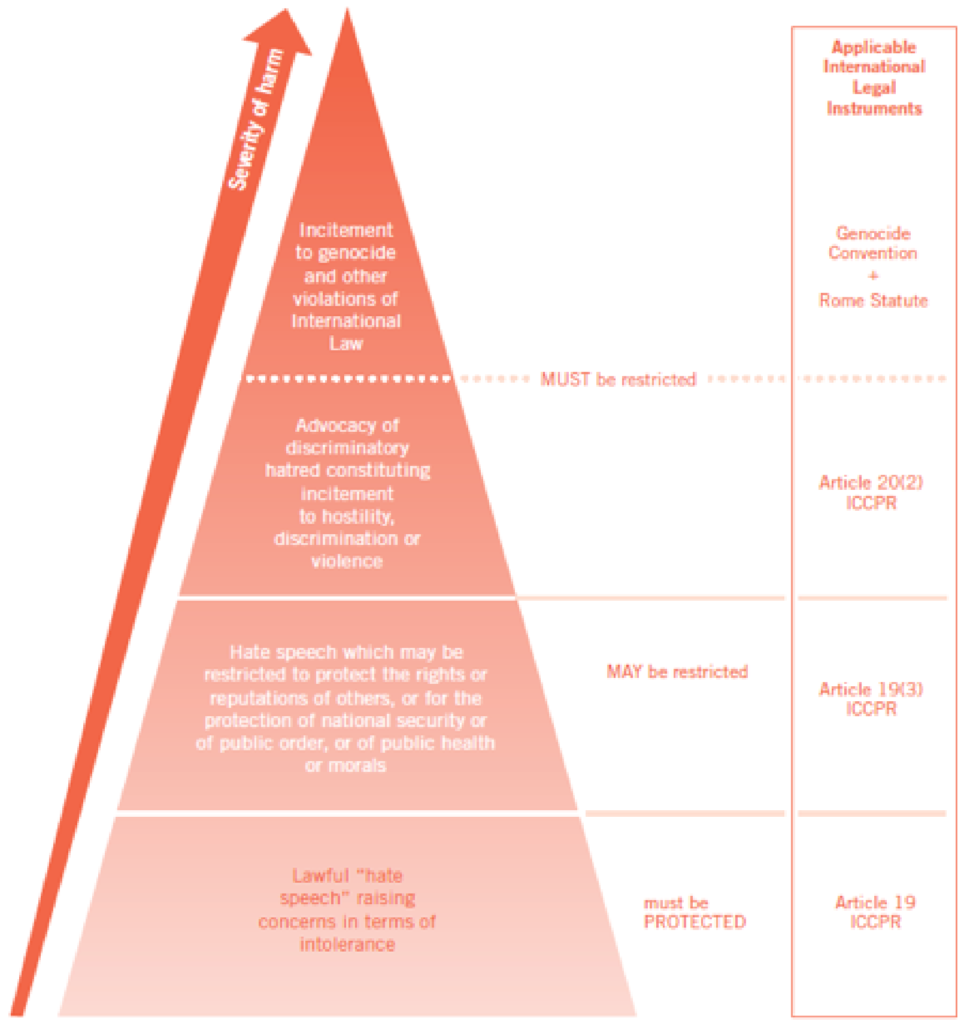
Finally, Article 19, an organization focused on speech issues, demonstrates the need to balance freedom of speech with the harm of hate speech in its “Hate Speech Pyramid” below (from Article 19, ‘Hate Speech’ Explained: A Toolkit, 2015)
Finally, Article 19, an organization focused on speech issues, demonstrates the need to balance freedom of speech with the harm of hate speech in its “Hate Speech Pyramid” below (from Article 19, ‘Hate Speech’ Explained: A Toolkit, 2015):
For more information about hate speech, please see our Resources page.